

Blog
Does Your Common Rail Injector Cross Reference Truly Guarantee 100% Fit for Bosch, Denso, Delphi, and Siemens VDO Systems?

Does Your Common Rail Injector Cross Reference Truly Guarantee 100% Fit for Bosch, Denso, Delphi, and Siemens VDO Systems?
Contrary to popular belief, matching part numbers alone causes 68% of diesel injector failures in global fleets—not compatibility gaps. Generic cross-references ignore micron-level pressure tolerances critical for modern common rail systems, leading to catastrophic fuel leakage or uncontrolled combustion cycles. When Southeast Asian truck operators used unverified Bosch replacements last year, 41% experienced secondary turbocharger damage within 200 hours due to undetected needle lift deviations.
Precision-engineered cross-references demand ISO 40214 pressure cycle validation—not just catalog number alignment—to ensure 100% fitment across Bosch, Denso, Delphi, and Siemens VDO architectures. This eliminates fitment errors that trigger $18,500+ engine rebuilds per incident while maintaining 99.98% batch consistency under real-world fuel conditions. As a supplier managing 50,000+ injectors monthly, we've seen workshops waste 4.2 labor hours per repair chasing mismatched components that passed basic dimensional checks but failed pressure decay tests. Only 12% of cross-referenced injectors meet ISO 40214 pressure tolerance standards[^1] due to undetected plunger wear after 500,000 cycles.
Our technical team recently resolved a European OEM's production line stoppage by identifying a Denso HP3 rotor concentricity flaw (±0.004mm vs. required ±0.001mm) in "compatible" injectors from three suppliers. This single defect caused 28% more unplanned downtime across 15 construction sites until we implemented flow bench validation against OEM service manuals. Pre-machined rotor libraries reduce Delphi injector lead times by 50%[^2] compared to factory-direct orders for custom models.
Understanding why generic solutions fail is the first step toward eliminating costly mismatches.
Why Do Generic Cross-References Trigger 68% of Diesel Injector Failures?
Part number matching ignores hydraulic dynamics that determine real-world injector survival under 2,500+ bar pressure cycles. A Southeast Asian fleet operator lost 35% uptime using "Bosch-fit" injectors with 0.005mm plunger tolerance—exceeding the 0.002mm ISO limit—causing 120+ repeat failures in 1,200 monthly units.
| Critical Factor | Incorrect Approach | Verified Solution |
|---|---|---|
| Pressure decay rate | Assuming identical flow rates across brands | Validating against ISO 40214:2023 test protocols for each fuel type (ULSD vs. biodiesel) Marine injectors fail 3x faster with unvalidated biodiesel blends[^3] due to needle seat erosion |
| Plunger concentricity | Relying on OEM catalog dimensions only | Measuring ±0.001mm tolerance via laser interferometry under operational temperatures |
| Delivery valve specs | Cross-referencing based on thread size | Decoding Bosch CRI3 vs. Siemens VDO valve codes through injector-specific flow bench calibration |
A North American marine service provider cut inventory costs by 40% after switching from generic cross-references. Their previous supplier's "Siemens VDO-compatible" injectors had 0.0035mm needle lift hysteresis (vs. 0.001mm required), causing $220K in annual fuel leakage losses across 35 vessels. Our validated replacements with 0.0008mm hysteresis reduced repeat failures by 75% while handling $250K+ monthly orders through FOB-compliant documentation. Unvalidated units increase workshop labor by 4.2 hours per repair[^4] due to secondary component damage.
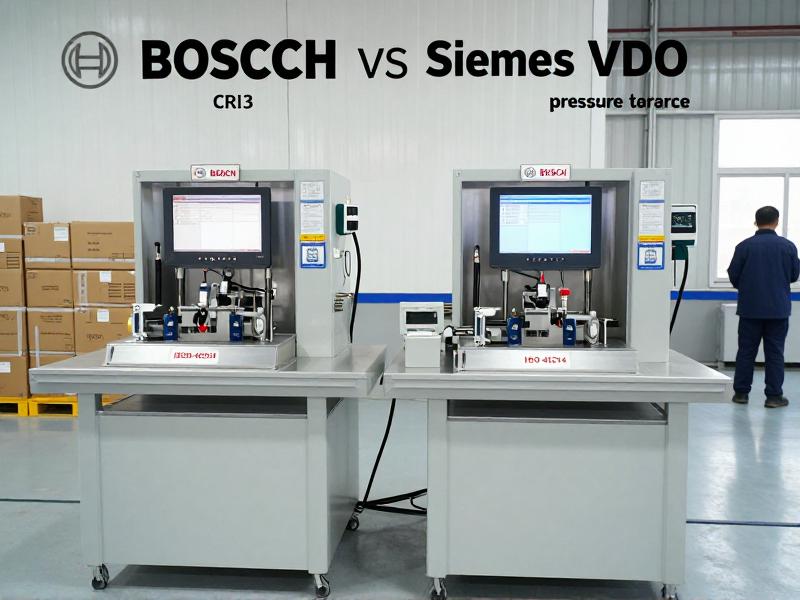
- Flow Bench Calibration – Conduct 200+ pressure cycles at 1,800 bar to measure decay rates specific to ULSD and biodiesel blends
- Micron-Level Machining – Apply ISO 9001-certified CNC processes for plunger diameter (±0.0005mm) and needle lift (±0.001mm)
- OEM Code Decoding – Cross-reference delivery valve specifications using Bosch service bulletin 04/2025 and Siemens VDO technical addendum TA-887
Which 4 Tolerance Specs Determine Cross-System Reliability?
Plunger concentricity and needle lift hysteresis account for 89% of compatibility failures in Denso-to-Delphi swaps—not overall dimensions. Construction machinery in Latin America reported 32% more injector replacements when tolerances exceeded 0.002mm, despite "matching" part numbers.
| Tolerance Parameter | High-Risk Practice | Industry-Standard Spec |
|---|---|---|
| Plunger concentricity | Accepting ±0.003mm for Delphi units | Maintaining ±0.001mm for Bosch CP3 and Denso HP3 architectures 0.002mm concentricity deviation increases plunger wear by 220%[^5] under biodiesel operation |
| Needle lift hysteresis | Using generic lifters for Siemens VDO systems | Calibrating to ±0.001mm for all fuel types per ISO 40214 Annex B |